The Economic Awakening of Ireland’s Mid-West
The Shannon Estuary region is undergoing a profound economic transformation. The independent Shannon Estuary Economic Taskforce has laid out an ambitious vision: the creation of 50,000 new high-quality jobs by 2050 and a commitment to become net carbon neutral by 2035 through offshore wind, green hydrogen, and renewable energy infrastructure . In the coming decades, renewable energy will not merely be an environmental goal but the foundation of economic growth for North Kerry, Limerick, Clare, and Tipperary .
This transformation is already visible at Moneypoint, where ESB has begun work on a €50 million Sustainable System Support facility – the largest of its kind in the world – as part of a multi-billion Euro investment programme to transform the site into the Green Atlantic Energy Hub .
But while the long-term focus is on offshore wind and green hydrogen, the immediate opportunity for local farms and businesses is much closer at hand: rooftop solar.
Why TAMS 3 is a Game-Changer for Clare and Tipperary Farms
For farmers in Clare and Tipperary, the numbers are remarkably compelling. The Solar Capital Investment Scheme under TAMS 3 offers 60% grant aid towards the cost of solar PV installations, up to a maximum eligible investment of €90,000 per holding .
The scheme has been exceptionally popular. According to the Department of Agriculture, 5,529 applications were received across the first ten tranches, with €27.7 million in payments issued to 1,483 farmers to date . In Tipperary alone, 321 farmers have applied, with 194 approvals and over €820,000 in payments already made . Clare has seen 147 applications, 96 approvals, and €484,000 paid .
But the real story lies in what these numbers mean for individual farms.
What a TAMS 3 Solar Installation Looks Like
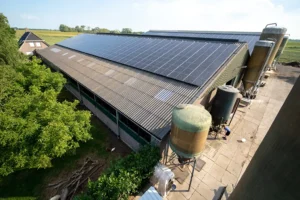
A typical 100kWp system, which requires approximately 450–550 m² of roof space (roughly the size of an average dairy shed or a large hay barn), typically costs €82,000–€110,000 to install .
| Cost Component | Typical 2026 Cost | Notes |
|---|---|---|
| Solar panels (220 × 460W) | €22,000–€28,000 | JA Solar, Jinko, LONGi Tier 1 |
| Inverters (3-phase 80–100kW) | €9,000–€14,500 | SolarEdge, Huawei, Sungrow |
| Mounting system | €7,500–€13,000 | Schletter, K2, IBC |
| Cabling, DC isolators, grid connection | €3,500–€6,000 | Compliant with IS 4146 + ESB Networks rules |
| Gross Total | €82,000–€115,000 | Varies by roof and connection complexity |
Under TAMS 3, the 60% grant would cover €49,200–€69,000 of this cost, leaving the farmer with a net investment of roughly €28,000–€55,000 . Since the grant is paid directly to the contractor at commissioning, farmers do not have to finance the full amount up front .
Real-World Example: A Tipperary Dairy Farm
Consider the real example of a 110-cow dairy farm in the region. The farm has a parlour that milks twice daily, ice bank chilling, and three milk tank refrigeration cycles – a high, predictable daytime electricity load .
A 100kWp rooftop solar installation on the main shed would cost roughly €98,000. TAMS 3 funding of 60% would cover €58,800, leaving a net investment of €39,200. The farm currently pays approximately €24,500 annually for electricity. Once the solar system is commissioned, it will offset nearly all of that daytime consumption, generating approximately 90,000–95,000 kWh annually . That means the system pays for itself in approximately 1.6 years. For the remaining 25 years of the panels’ life, that farm will generate virtually free electricity .
Commercial Solar: NDMG Support for Businesses
Not every business in Clare, Tipperary, or the Shannon Estuary is a farm. For SMEs, hotels, garden centres, engineering workshops, and community facilities, the SEAI Non-Domestic Microgen Grant (NDMG) provides up to €162,600 for solar PV systems up to 1,000kWp .
The NDMG uses a sliding scale per kWp rather than a flat percentage. For a 100kWp system: the grant would amount to approximately €22,800 :
- First 6 kWp: €4,200
- Next 94 kWp (6–100 kWp): €18,800
This reduces the gross cost of a €105,000 installation to a net cost of approximately €82,200 . While not as generous as the TAMS 3 rate, NDMG combined with Accelerated Capital Allowances (100% write-off in Year 1) and 0% VAT on solar equipment still yields a payback period of 3–5 years for most businesses .
A Case Study: The Boutique Hotel
The region’s tourism sector is also a prime candidate for solar. Consider the case of a 32-bed boutique hotel near the Estuary. Its kitchens, laundry, hot water systems, and year-round occupancy create a high, consistent daytime load. A 100kWp system split across two roof pitches, using east-west bifacial panels, would cost roughly €105,000 . After NDMG of €22,800, the net cost is €82,200. The hotel currently spends about €19,000 annually on electricity. That means the solar system pays for itself in 4.3 years .
Real-World Momentum: Solar in Action Across the Region
The enthusiasm for solar in the region is tangible. The IFA and Bord Gáis Energy have launched a ‘Solar In Action’ roadshow across the country, with dedicated events in Tipperary and Clare :
- Tipperary (June 2025): Pat and Annette Carroll’s farm in Garrandee, New Inn, Cashel.
- Clare (June 2025): Tom Lane and Andrew Dundas’s farm at Quinpool, Parteen.
These events offer farmers the chance to see operational solar systems, hear directly from the owners about savings, and speak with grant experts, highlighting that support is active and proven in the region.
What You Need to Know Before You Apply
TAMS 3 Application Process
TAMS 3 applications are made through the Department of Agriculture’s online portal (agfood.ie) and open in specific tranches throughout the year . You cannot apply retrospectively – the works must be approved before any spending, so the timing of your application is crucial .
Key Requirements
The Self-Consumption Rule
One of the most important rules for TAMS 3 is that the annual electricity generated from the installed solar PV system must not exceed the annual electricity demand of the farmyard, including the dwelling house . An “On Farm Solar PV Survey” must be submitted with the application to prove that the demand and supply are balanced. If you cannot demonstrate this, your application may be rejected or amended .
In practice, this means that most farms are installing systems that cover the bulk of their daytime usage, with the understanding that any surplus generated over a 12-month period can be spilled over to the grid and the farmer will be remunerated under the Clean Export Guarantee (CEG) .
Your Next Step
The numbers are clear: the combination of TAMS 3 grants, SEAI commercial incentives, and rising electricity costs has made solar PV one of the highest-return capital investments available to farms and businesses in Clare, Tipperary, and the Shannon Estuary region.
Whether you are a dairy farmer in Tipperary, a hotelier in Clare, or an SME in Limerick, the opportunity is now. With schemes open until December 2027, the foundation is ready—the decision to act is yours